Calibrated arm system
The arm, gripper, cameras, work zone, local controller, and safety limits are configured as one task-specific system.
Physical integration pending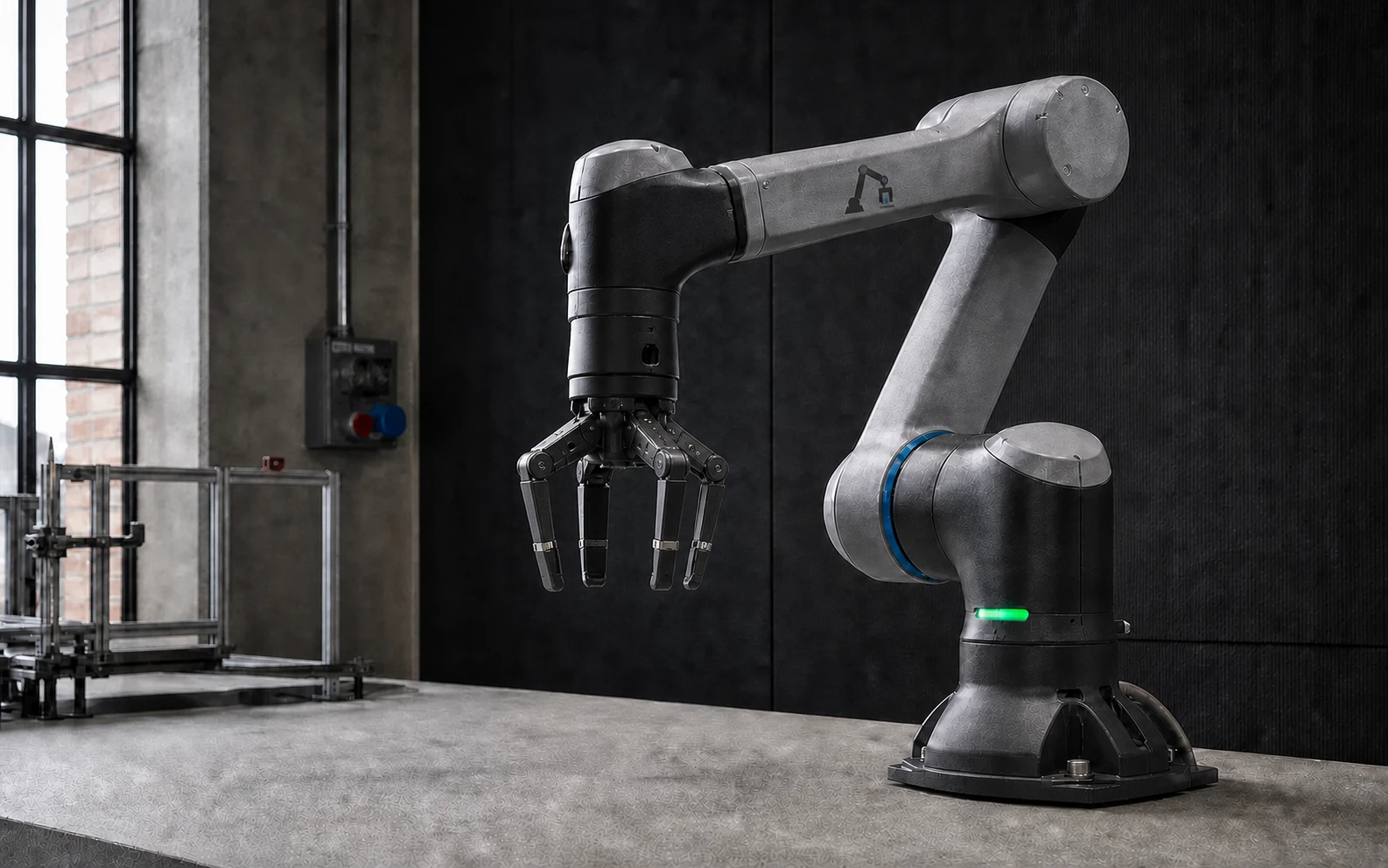
Krafters Robotics / Robot arms for commercial work
A person demonstrates the task. The arm records what happened. Arm-specific robot models are then trained to handle repeatable work while people remain available for exceptions.
See the system01 / System
Early systems combine the arm, cameras, human control, safety boundaries, and task recording. Each run is structured so demonstrations and corrections can become training material instead of disappearing after the job.
The arm, gripper, cameras, work zone, local controller, and safety limits are configured as one task-specific system.
Physical integration pendingA person controls the arm or gives an instruction, completes the task, and takes over when an edge case needs judgement.
Working in simulationCamera views, robot state, commands, task context, outcomes, and human corrections are kept together for evaluation and model training.
Recorder path builtKrafters learning loop
Human operation is both the launch path and the data engine. The same person who gets the work done also supplies demonstrations and rare failure recoveries for the model built around that arm, tool, and workspace.
Map the exact arm, gripper, cameras, work zone, and safety limits before the first task run.
Next with hardwareA person performs the job and handles exceptions while the system records what was seen, commanded, and achieved.
Control + recording built in simulationThe synchronized runs fine-tune and evaluate an arm-specific vision-language-action model that learns repeatable task segments and recovery patterns.
Planned after physical task dataThe model handles proven work. A person takes over uncertain cases, and each correction becomes another training example.
Evidence-gated targetWhere the LLM fits
Recorded demonstrations fine-tune the robot model. The language model supplies intent and task context, while deterministic controls remain between model outputs and the arm.
Turns a spoken or written instruction into a constrained task plan.
Uses camera views, arm state, and task context to select the next bounded action and detect failure.
Checks limits and sends deterministic commands to the calibrated arm.
Current proof / Scripted simulation
One operator command starts the bounded task.
The simulated arm state and task progress remain visible while the run is active.
The completed run is confirmed and preserved as a reviewable task record.
This proves the operator-triggered simulation, bounded pick/move/place sequence, active recording state, and saved task outcome. It does not prove physical hardware, model training, or autonomous execution.
02 / Commercial workflows
Photoreal workflow concepts, not customer deployments. Each record defines the task, human responsibility, and failure handoff that physical trials must validate.
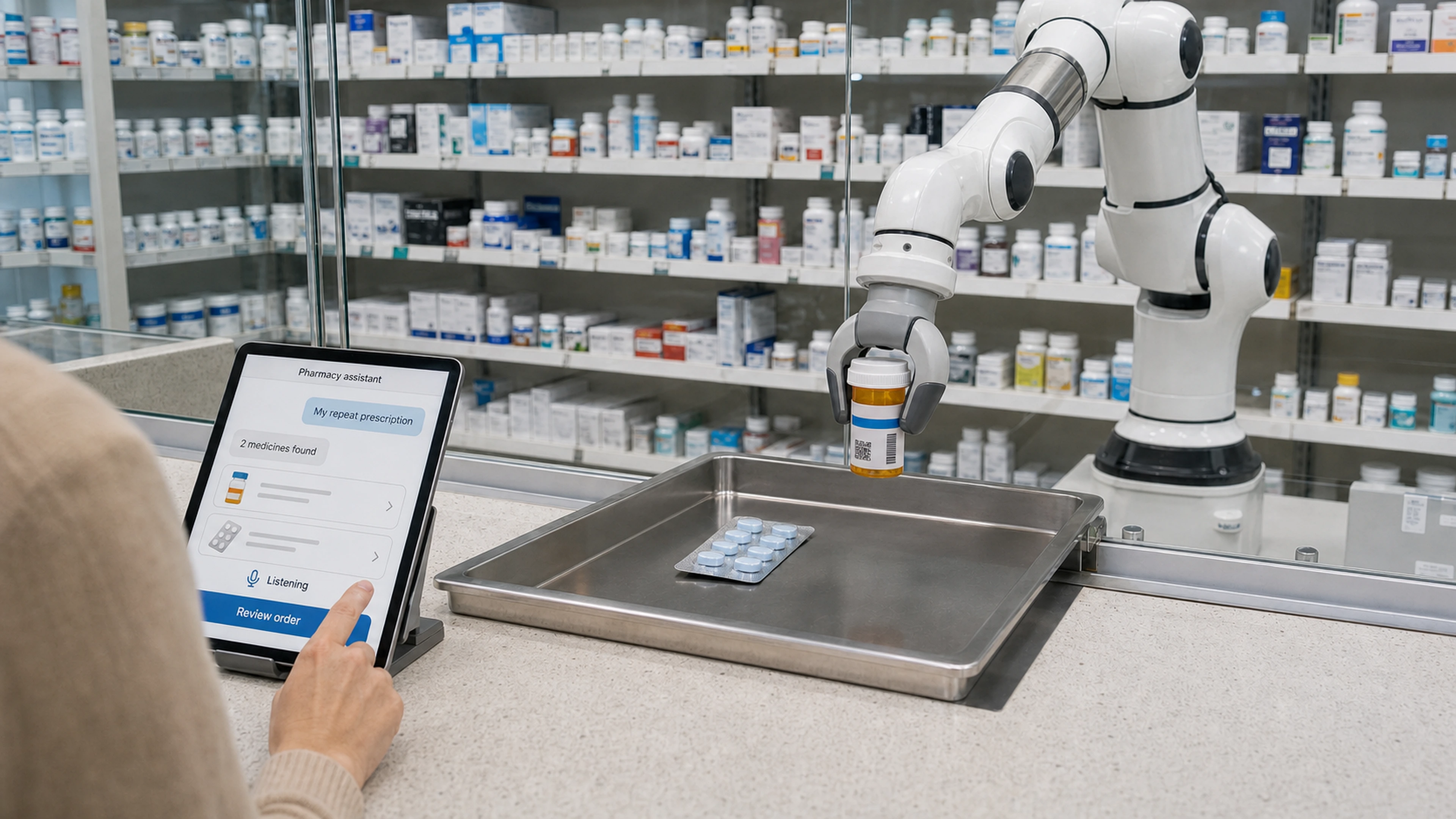
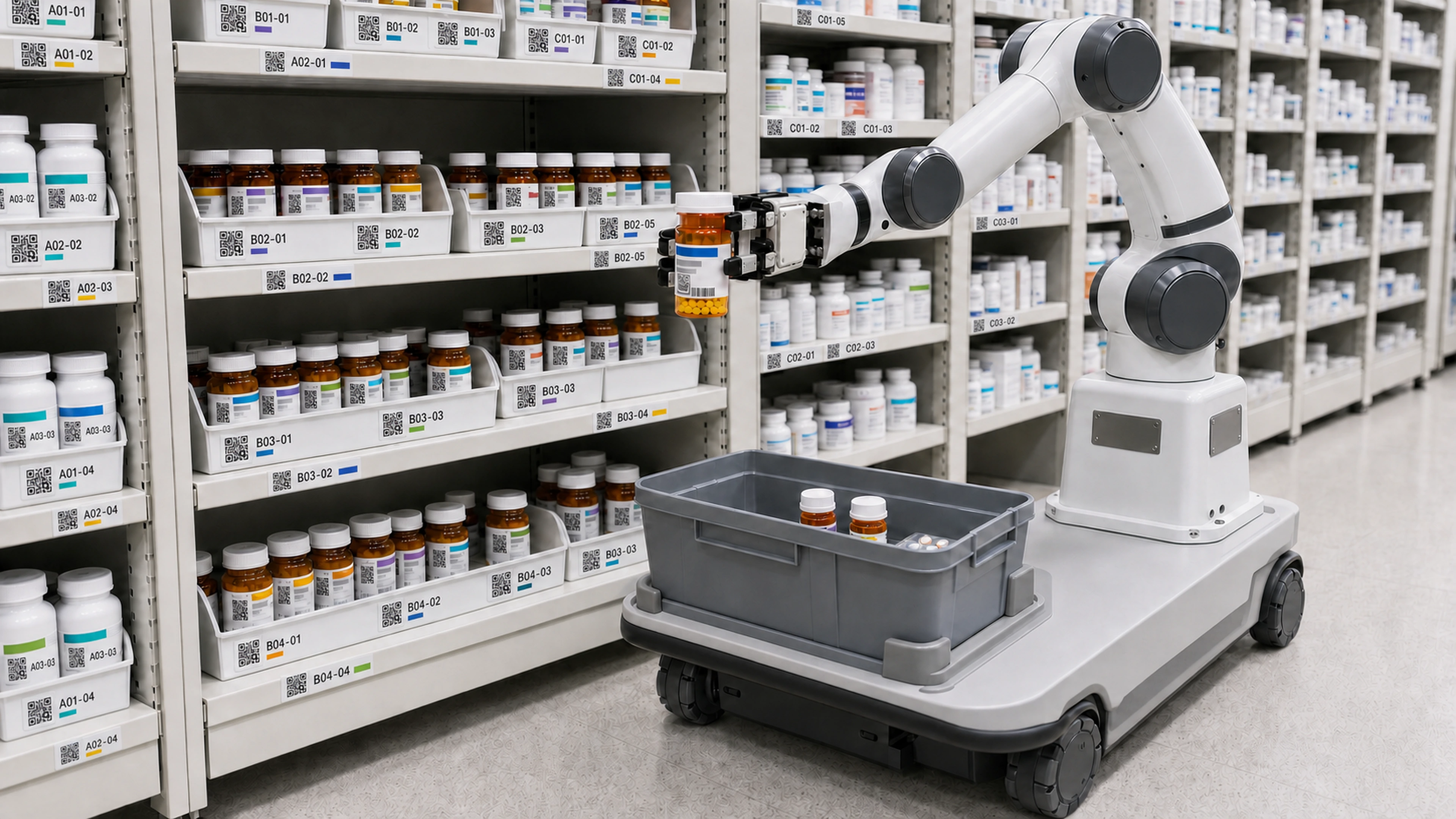
A counter arm holds a sealed medicine order at a defined transfer point while the customer reviews it on a tablet. A mobile arm retrieves and replenishes packaged stock in a restricted area. Clinical judgement and release remain with authorised pharmacy staff.
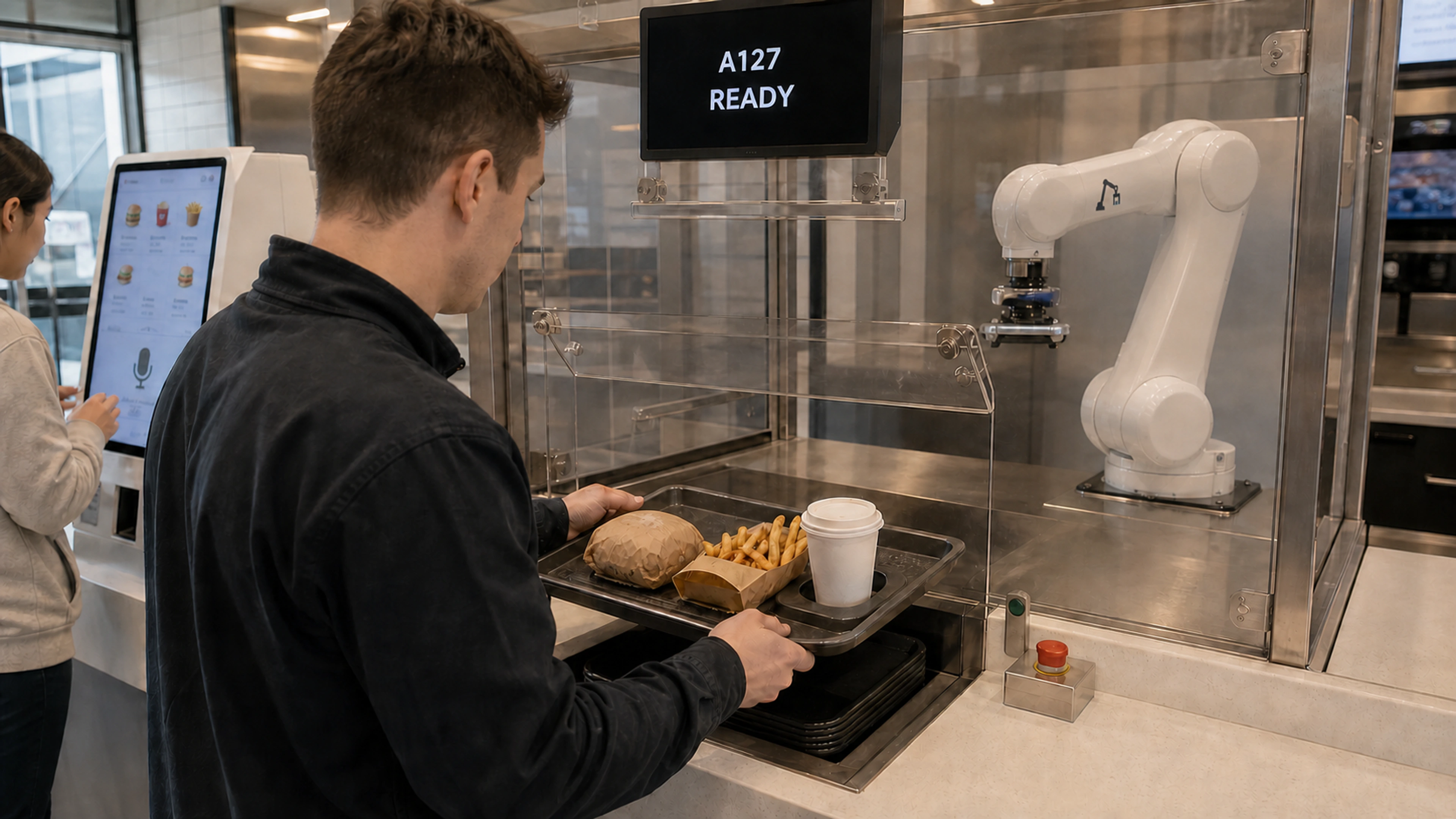
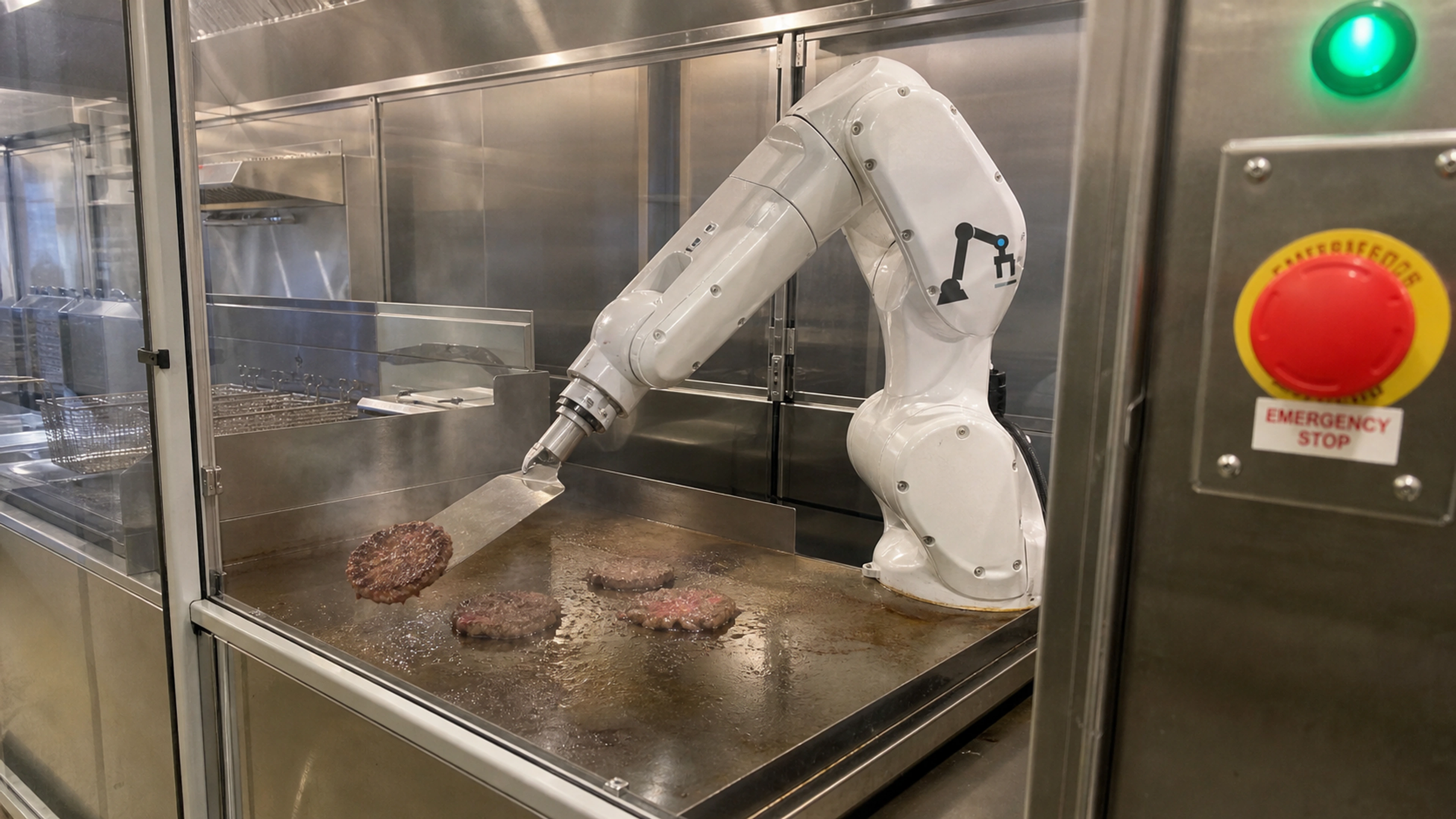
A customer orders at the kiosk. After the robot loads the top tray and retracts, the rear safety shutter locks before the customer hatch opens. The customer removes the numbered tray and the next clean tray rises. A separate enclosed arm handles a bounded cooking task with a sanitary turner.
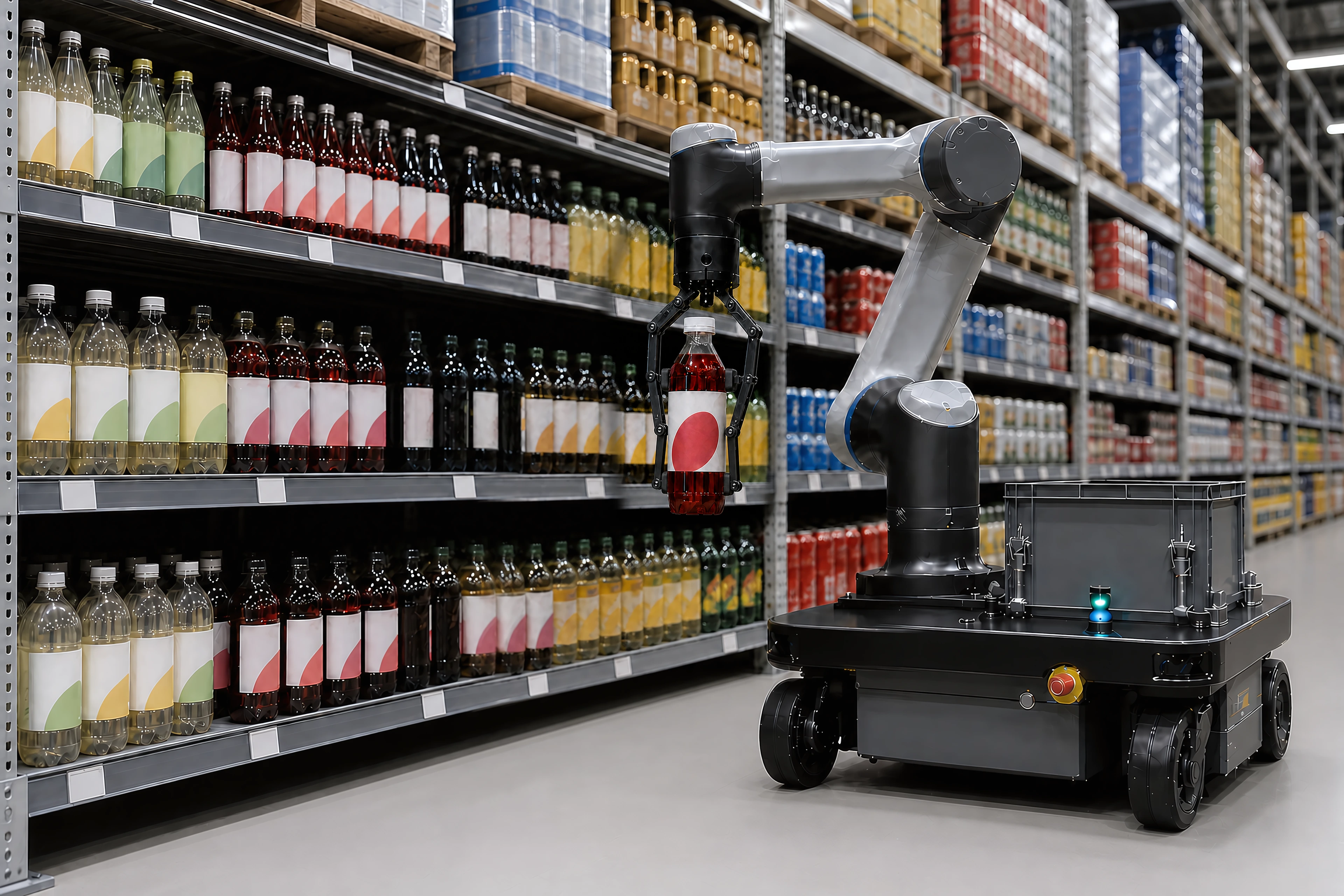
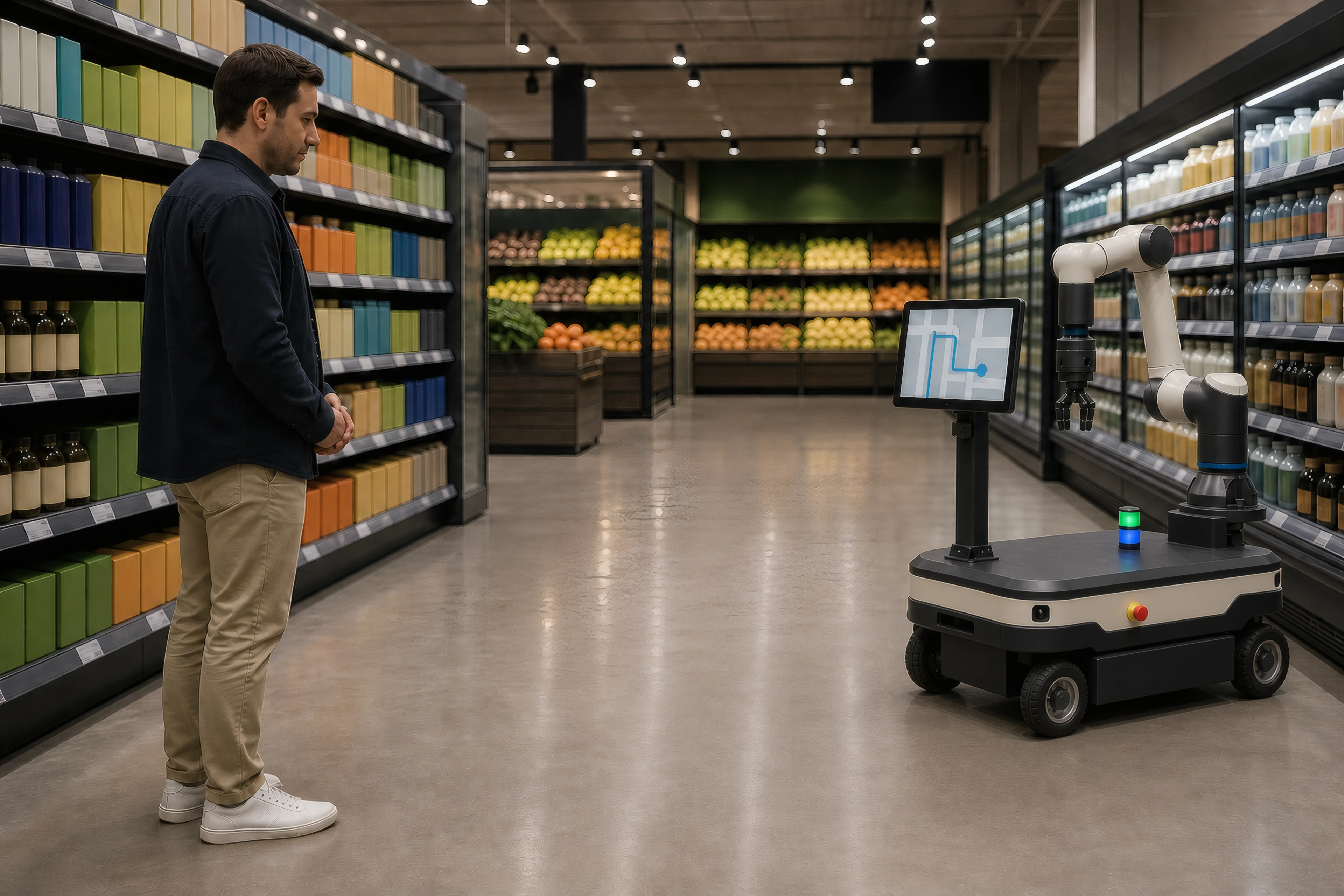
A mobile arm replenishes packaged goods from a stock cart while a separate unit provides on-screen aisle guidance without touching shoppers or entering their path.
03 / Training record
The intended data advantage is a growing record tied to the exact arm, task, action, result, and recovery. That structure makes demonstrations and corrections useful for model training and repeatable evaluation.
The requested job, object, workspace, constraints, and operator instruction stay attached to the run.
Why the work was doneCamera views, calibration, joint state, gripper state, and work-zone context are synchronized.
What the arm observedOperator input, controller commands, task progress, and success or failure are preserved together.
What happened nextThe intervention point, human recovery, and replay result become evidence for training and evaluation.
What the model must learn04 / Evidence register
| Evidence | What exists | Status |
|---|---|---|
| Robot-arm control | ROS2 control path and simulated arm state | Built in simulation |
| Operator surface | Controls, presets, task state, and stop path | Built in simulation |
| Task recording | Session-linked state, action, timing, and outcome record | Recorder path built |
| Physical system | Commercial arm, cameras, safety system, and local control PC | Pending hardware |
| Training pipeline | Task dataset, evaluation suite, and arm-specific robot model | Planned after physical data |
| Learned execution | Instruction-led task policy with human fallback | Target; not a current claim |
05 / Pilot definition
We will map the work zone, intervention policy, evidence requirements, and operating constraints before proposing a trial.
Send a workflow brief